Why Sourdough Bread Does Not Rise: The Ultimate Troubleshooting Guide for Open Crumb & Blistered Crusts
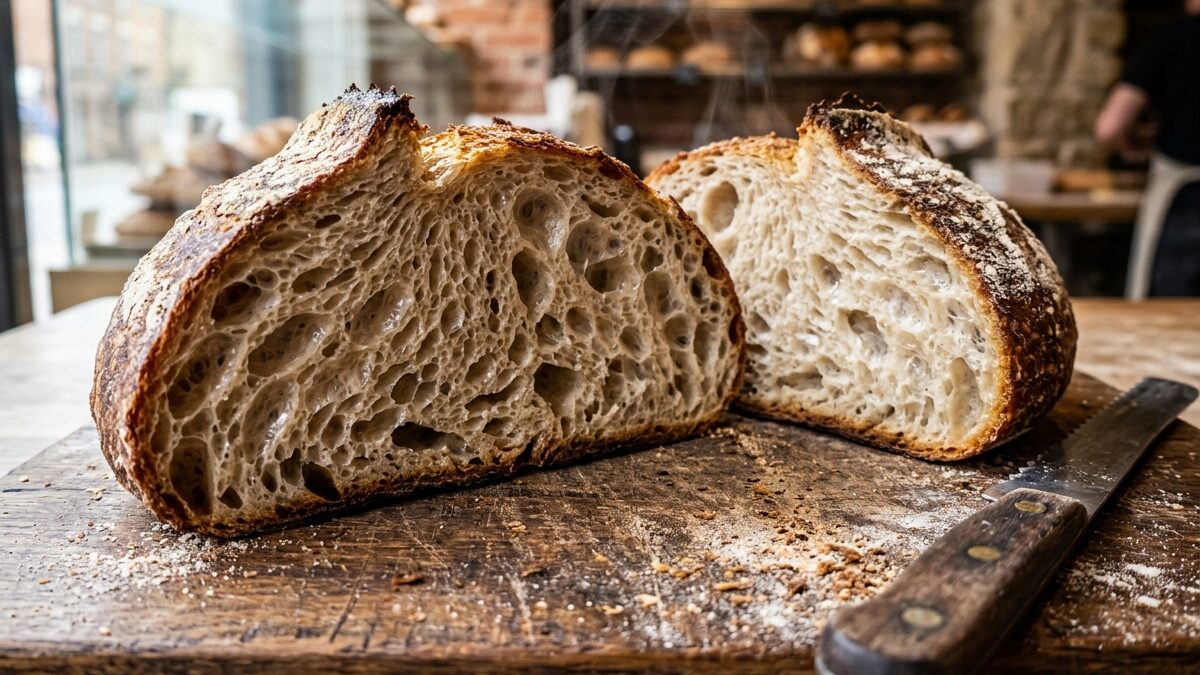
Why is your sourdough bread gummy, flat, or dense? Our laboratory fermentation guide explores yeast kinetics, gluten extensibility, autolyse timing, and steam baking science to help you achieve an open honeycomb crumb.
A dense, flat sourdough loaf (the dreaded "flying crust" or gummy brick) is almost never caused by faulty scoring; it is a breakdown in fermentation kinetics. Wild yeast (Candida humilis) provides carbon dioxide gas expansion, while lactic acid bacteria (Fructilactobacillus sanfranciscensis) produce organic acids. If bulk fermentation is truncated too early (underproofed), gluten sheets lack the extensibility to capture steam. If allowed to overproof, bacterial proteolysis digests the gluten matrix, causing the dough to collapse into a pancake upon hitting oven heat.
Step-by-Step Instructions
1
LEVAIN TIMING TEST: Feed your mature sourdough starter 1:2:2 with warm water 4 to 5 hours before mixing. Only use it when it has tripled in volume, shows domed bubbly surface tension, and passes the float test in room temperature water.
2
THE AUTOLYSE: In a large glass bowl, combine the 450g bread flour, 50g whole wheat, and 350g water (reserve 25g). Mix until no dry flour remains. Cover and let rest for 45 minutes to initiate enzymatic starch-to-sugar conversion and passive gluten alignment.
3
INCORPORATING STARTER & SALT: Spread the 100g active levain over the dough and dimple in. Rest 20 minutes, then sprinkle the 10g salt and remaining 25g water. Perform 3 minutes of Rubaud mixing or slap-and-folds until the dough tightens and releases cleanly from bowl walls.
4
BULK FERMENTATION & FOLDS: Keep dough in an ambient environment of 24°C–26°C (76°F–78°F). Perform 3 sets of stretch-and-folds spaced 30 minutes apart, followed by 2 gentle coil folds. Monitor volume rise: look for 45-50% volume expansion, aerated domed edges, and translucent sub-surface bubbles—not clock time.
5
PRE-SHAPE & BENCH REST: Turn dough onto an unfloured work surface. Use a bench scraper to shape into a taut round boule. Rest uncovered for 20 minutes to relax gluten tension.
6
FINAL SHAPING & COLD RETARD: Dust a rice-flour banneton. Stitch the dough using the envelope method into a tight batard with strong surface tension. Cover in a plastic bag and retard in a 3°C–4°C (38°F) refrigerator for 14-16 hours. Cold slows yeast while allowing bacterial enzymes to develop complex flavor and blistered skin.
7
STEAM BAKING: Preheat a heavy cast iron Dutch oven inside the oven at 250°C (485°F) for 60 minutes. Invert cold dough onto parchment, score with a razor at a 30° angle 1/4-inch deep to form a prominent ear. Bake covered for 20 minutes with lid on (trapping internal steam), then remove lid, reduce to 220°C (430°F), and bake 20 more minutes until mahogany dark with an internal temperature of 98°C (208°F).
Why is your sourdough bread gummy, flat, or dense? Our laboratory fermentation guide explores yeast kinetics, gluten extensibility, autolyse timing, and steam baking science to help you achieve an open honeycomb crumb.
A dense, flat sourdough loaf (the dreaded “flying crust” or gummy brick) is almost never caused by faulty scoring; it is a breakdown in fermentation kinetics. Wild yeast (Candida humilis) provides carbon dioxide gas expansion, while lactic acid bacteria (Fructilactobacillus sanfranciscensis) produce organic acids. If bulk fermentation is truncated too early (underproofed), gluten sheets lack the extensibility to capture steam. If allowed to overproof, bacterial proteolysis digests the gluten matrix, causing the dough to collapse into a pancake upon hitting oven heat.
Step-by-Step Culinary Protocol
LEVAIN TIMING TEST: Feed your mature sourdough starter 1:2:2 with warm water 4 to 5 hours before mixing. Only use it when it has tripled in volume, shows domed bubbly surface tension, and passes the float test in room temperature water.
THE AUTOLYSE: In a large glass bowl, combine the 450g bread flour, 50g whole wheat, and 350g water (reserve 25g). Mix until no dry flour remains. Cover and let rest for 45 minutes to initiate enzymatic starch-to-sugar conversion and passive gluten alignment.
INCORPORATING STARTER & SALT: Spread the 100g active levain over the dough and dimple in. Rest 20 minutes, then sprinkle the 10g salt and remaining 25g water. Perform 3 minutes of Rubaud mixing or slap-and-folds until the dough tightens and releases cleanly from bowl walls.
BULK FERMENTATION & FOLDS: Keep dough in an ambient environment of 24°C–26°C (76°F–78°F). Perform 3 sets of stretch-and-folds spaced 30 minutes apart, followed by 2 gentle coil folds. Monitor volume rise: look for 45-50% volume expansion, aerated domed edges, and translucent sub-surface bubbles—not clock time.
PRE-SHAPE & BENCH REST: Turn dough onto an unfloured work surface. Use a bench scraper to shape into a taut round boule. Rest uncovered for 20 minutes to relax gluten tension.
FINAL SHAPING & COLD RETARD: Dust a rice-flour banneton. Stitch the dough using the envelope method into a tight batard with strong surface tension. Cover in a plastic bag and retard in a 3°C–4°C (38°F) refrigerator for 14-16 hours. Cold slows yeast while allowing bacterial enzymes to develop complex flavor and blistered skin.
STEAM BAKING: Preheat a heavy cast iron Dutch oven inside the oven at 250°C (485°F) for 60 minutes. Invert cold dough onto parchment, score with a razor at a 30° angle 1/4-inch deep to form a prominent ear. Bake covered for 20 minutes with lid on (trapping internal steam), then remove lid, reduce to 220°C (430°F), and bake 20 more minutes until mahogany dark with an internal temperature of 98°C (208°F).